
Back to LING 385
Lecture 18
Three Key Linguistic Principles
- Principle of the Category: Every word has a category
- Principle of Phrase Structure: Words combine with each other to form phrases.
- Principle of Head Direction: Each phrase that has a head can have an order relation between head and the non-head.
Principle of the Category
- Noun Phrases (NP): dog, cat, bottle, state
- Verb (V): eat, drink, think, travel, went, slept
- Adjective (Adj): bright, high, sick, green
- Adverb (Adv): slowly, well, nicely, brightly
- Preposition (P): to, from, in, on, below
- Determiner (D): a, the, my, her, their, this, that (they determine an aspect of an NP, e.g., the dog vs. a dog, my cat vs. their cat)
- Complementizer (C): that, if (they introduce an entire sentence, e.g. I think that the door closed, I don’t know if the door closed).
- Determiner Phrase (DP): Sally, Hanako, he, they, them, Paris, himself, Chile (they refer to complete entities)
Principle of Phrase Structure
- phrase = words that go together
- for instance, DP (this movie) → D (this) NP (movie)
- a determiner phrase consists of a determiner and a noun phrase
- PP (to the park) → P (to) DP (the park)
- a preposition phrase consists of a preposition and a determiner phrase
- hence, phrases can contain other phrases
- VP (liked the movie) → V (liked) DP (the movie)
- a verb phrase consists of a verb and a determiner phrase
- sometimes, VP (went to the park) → V (went) PP (to the park)
- or, other times, VP (slept) → V (slept)
- a complete thought is expressed via a sentence (S)
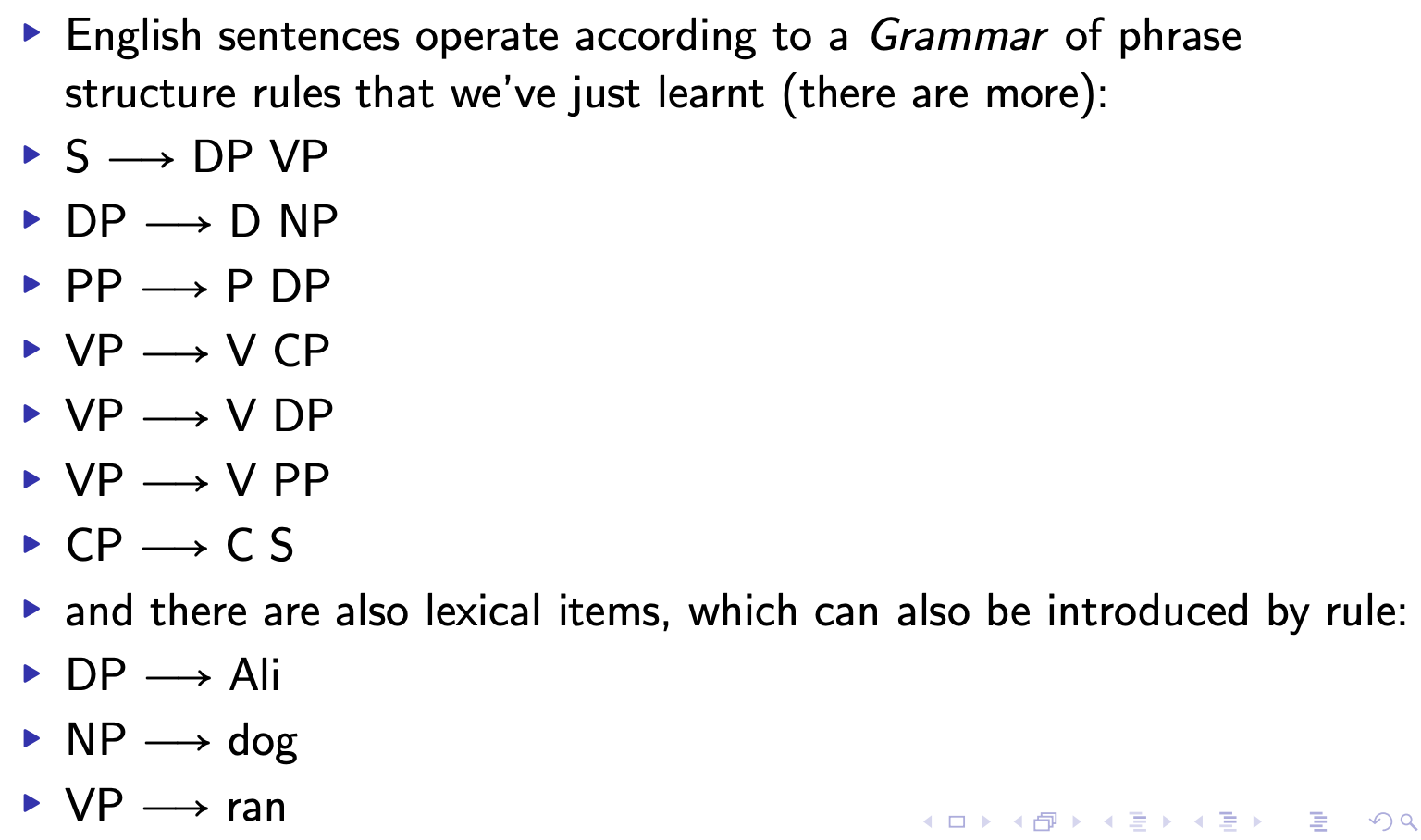
- we can represent each rule as a tree to reveal the structure of a sentence!
.png)
Principle of Head Direction
- head of a phrase is the "important" word of the phrase
- V is the head of VP. C is the head of CP. D is the head of DP. P is the head of PP.
- In English, the Head comes before the non-head; In Japanese, the head comes after the non-head.
- English: DP → D NP; Japanese: DP → NP D
- English: VP → V CP; Japanese: VP → CP V
Recap
- words go together to form phrases
- words build together to build phrases, which build into other phrases, etc
- up to a whole sentence
- our intuition for English tells us which words go together
- phrase represents a hidden hierarchical structure
- Is there evidence that your mental representation of English includes this hidden structure?
- Yes! To assign meaning to sentences, you combine the words into phrases!