
Back to LING 385
Lecture 20
Transformer/LLM General Structure
- neural network takes a vector ⇒ creates a new better representation which is better at solving the problem at hand
- LLMs have hundreds/thousands of NNs, each of which produce a better representation
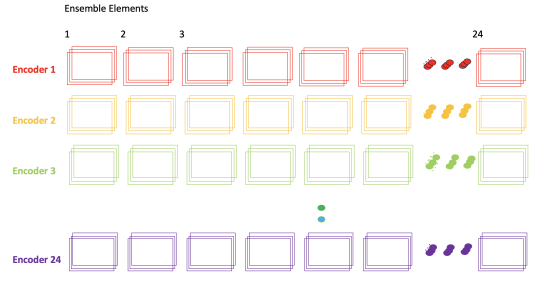
- each element of Ensemble has 3 NNs: Q, K, V
- gradually, from one Encoder to another, the vectors are moved around to become more like the distances in the hierarchical/structural distances
LLMs are Loss Minimization (Error-based) Learners
- BERT: give the LLM a sentence, eliminate one or more of the words, and ask the LLM to guess the missing words
- GPT: give the LLM a sequence of words, ask the LLM to guess the next word
-
- pick a sentence from wikipedia; 2) pick a random (nth) word; 3) goal of GPT system is to predict n+1th word
-
- how can GPT predict a word from other words?
- must know the relationship of words in the sentence
- hierarchical structure
What GPT accomplishes (approx)
.png)
- input to GPT is a sentence
- each word is represented by a vector
- word vector = embedding vector + positional encoding
- vectors have distances from each other that represent semantic similarity
- distances don't have anything to do with hierarchical/structural distances
- job of the Q, K, V NN's to learn tree structure
How GPT gets structure (approx)
- input vectors
- for each word, use Q NN to get new q vector representation (same with k and v)
- combine q_n with all other k's, and combine that with v_n
- crucial step to changing the location of each word's vector = relating it to others
- this is "attention" mechanism
- effectively an associative memory